Allahu Akhbar: Overwhelming Lostness

Post Icon

“Allahu Akhbar. Allahu Akhbar. Allahu Akhbar.”

Those were the words that pulled me out of a jet-lagged sleep on my very first mission trip. My first thought was, “This is what we came for.” My second—if I’m honest—carried a hint of fear: “But will they listen?”

Over the following weeks, I watched God move in ways that still stir my heart today. By the end of that trip, I knew I had to return. I went back for six more months and even began to consider committing my entire life to serving in Southeast Asia. I had learned that this region is home to the largest Muslim population in the world, and I sensed that the Lord was directing me specifically to reach Muslim communities.

But during that six-month stay, I came across a single statistic—a simple line of data—that altered not only my life but also the entire direction of my ministry. And that is what I want to share with you in this article.

The statistic that confronted me was this: the Muslim population of India is around 200 million. I remember staring at that number in disbelief. It felt impossible—India is known as a Hindu nation, so surely this had to be a mistake. I pulled out my phone, typed “How many Muslims are in India?” into Google, and there it was again: approximately 200 million. I checked the Joshua Project, and the same number appeared.

Once I saw it, I couldn’t shake it. I began asking others, and to my surprise, most people were just as stunned as I was. I asked whether anyone was focused specifically on these 200 million people, but almost no one could name a single person or organization.

This pushed me to look around at my own situation. In just six months—while serving in a fairly remote part of Southeast Asia—nearly twenty short-term workers had passed through, not counting my team of four. I’d met national missionaries and long-term personnel from at least three different organizations, all concentrating on populations of less than a million people. Eventually, someone mentioned one person who was working among Muslims in India. One.
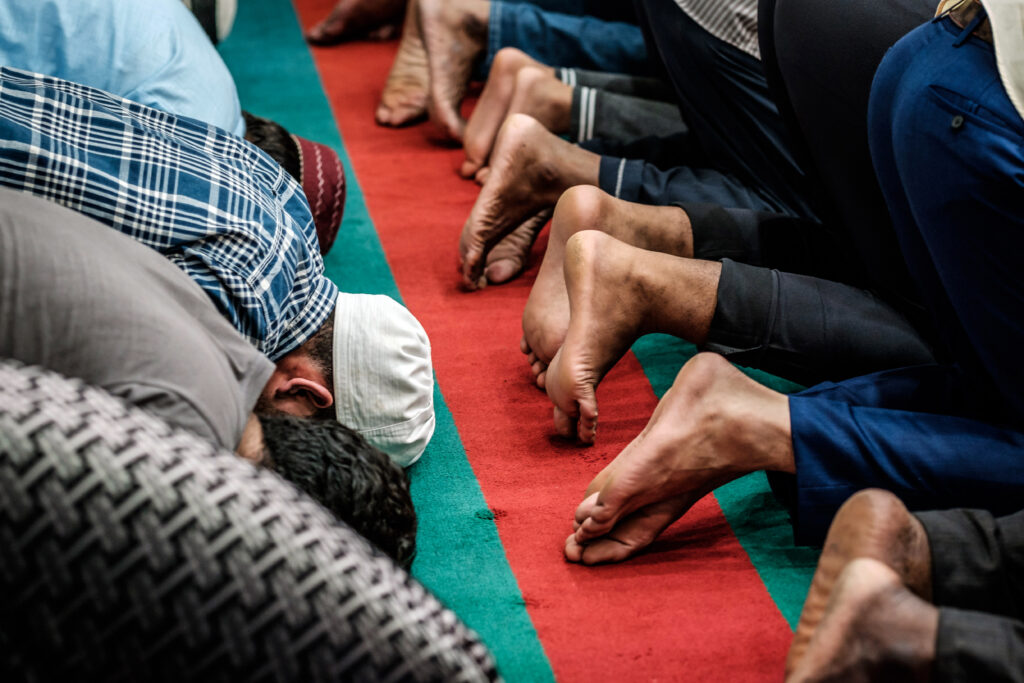
Then I heard it—the ringing of temple bells overpowering the faint call to prayer drifting from the local mosques, mosques that were full of Muslims.

One short year later, I found myself on a plane headed to Northeast India. As I began meeting people on the ground, I quickly learned that in an area roughly the size of Tennessee—spread across three states—there was only one family focused solely on the 54.6 million Muslims who call that region home. I was stunned. How? How was that possible?

The answer hit me in layers.

First, like most things in South Asia, I smelled it—the incense rising from offerings to Hindu gods. Then I heard it—the ringing of temple bells overpowering the faint call to prayer drifting from the local mosques, mosques that were full of Muslims. Then I saw it—the sheer volume of people everywhere I turned.

So how was it possible to overlook them? How could 200 million Muslims remain almost invisible? How could two-thirds of the population of the United States be hidden in plain sight?

I realized how: place them in a nation of 1.4 billion people—one that is increasingly proud of its Hindu identity and, in some circles, increasingly militant about erasing much of its Islamic past—and it becomes surprisingly easy for a massive population to go unnoticed by the outside world.

This idea of a hidden people has stayed with me ever since. And it’s why I want to bring them into the light—so that, by God’s grace, they might become the focus of more prayer, more mobilization, and greater visibility in the Great Commission efforts of Christians everywhere, especially among Southern Baptists.

We seek the Lord of the Harvest to raise up more laborers, we shine a light on these people that are so hidden in Darkness, and we rejoice in the promise that they will be gathered around the throne one day.

So let’s start with a question: Did you know—before reading this article—that there were Muslims in India? And if you did, did you know there are around 200 million of them? Did you know that, according to current projections, India will have the largest Muslim population in the world by 2050?

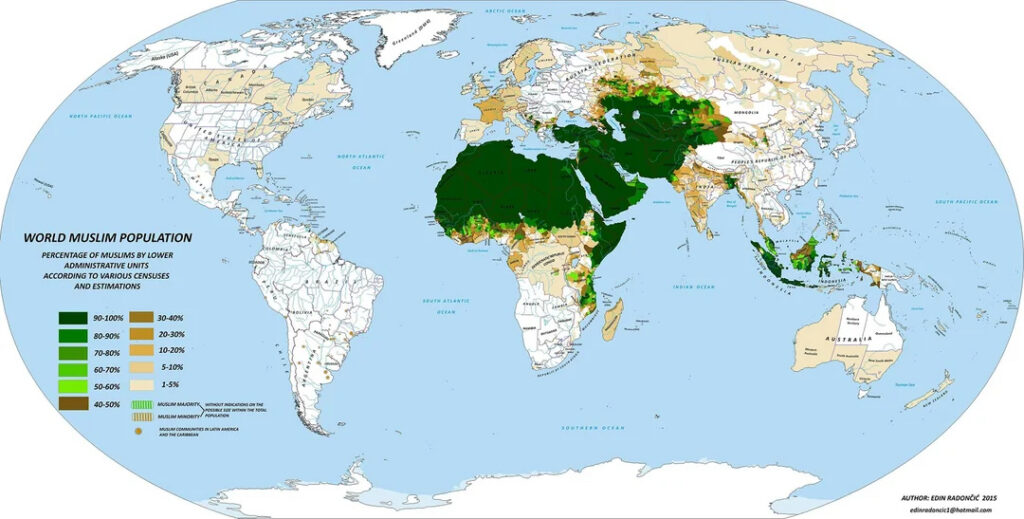
Did you know that maps can hide this reality? Take this map for example. It displays the percentage of Muslims in each country—dark green indicating a high percentage, tan indicating a lower one. Looking at it, you might assume India and France are on roughly the same level. But percentage maps hide population size. In reality, India has more Muslims than Egypt (~100M), Iraq (~40M), Afghanistan (~40M), and Malaysia (~20M) combined.

In India alone, around 2 million Muslims die each year—the equivalent of the entire Raleigh–Durham area—most without ever hearing the gospel. That breaks down to 5,479 Muslims dying every day, or the population of Huntsville, Alabama, every 45 days. Every 16 seconds, a Muslim in India enters a Christless eternity.

An average college football game lasts about three hours. In that time, around 675 Muslims die in India, more often than not, without the opportunity to hear the gospel.

So, what do we do?

We seek the Lord of the Harvest to raise up more laborers, we shine a light on these people that are so hidden in Darkness, and we rejoice in the promise that they will be gathered around the throne one day.

Will you pray for them? Will you go and labor among these people? Will you raise awareness about them in your churches so that Jesus receives the reward of his suffering from among these Muslim peoples?

Elizabeth Andrews

Resource Coordinator

Elizabeth Andrews spent five years with the International Mission Board in Europe working among Northern African and Middle Eastern diaspora communities. She has a heart for equipping the next generation, having mobilized and trained college students for overseas service. Now pursuing an MA in Cross-Cultural Counseling at Southeastern, Elizabeth loves a good adventure—whether it’s hiking in the mountains or getting lost in the pages of a book.

Subscribe to the CGCS Newsletter

to receive a biweekly roundup of current mission resources directly in your inbox.